Posts

A Timely Post

Image
A Timely Post   Pesachim 11-12 Yesterday’s mishnah and today’s daf spend a good amount of time discussing time-related issues. We start off with a disagreement between Rabbi Meir and Rabbi Yehuda about the time limit on eating  hametz on the 14 th of Nisan. The Gemara then launches into a discussion about rgw accuracy of witnesses’ testimony regarding time. If one witness says an incident occurred at the 3 rd hour and another says at the 5 th hour, can we synchronize their testimonies and say one meant the end of the 3 rd and one meant the beginning of the fifth? All these discussions are predicated on the fact that people had a sense of time, of the hours in the day. But just how did they tell time before digital watches, cellphone clocks and even Greenwich Mean Time? When the Gemara speaks about hours (the third hour, the fifth hour), it means שעות זמניות , the division of the time between sunrise and sunset into twelve equal pieces. Obviously the length ...

How many locks? Guest blog: Eli Duker!

Image
Eruvin 101 How many keys-locks-walls?? By Eli Duker, guest blogger and guide Model of Antonia Fortress, where the second wall began The  Mishna brings a dispute between Rabbi Meir on one hand, and the Sages and Rabbi Yose on the other, regarding the permissibility of unlocking a door when one is in a different reshut than the door. Rabbi Meir forbids it, and the Sages permit it based on their claim that in people were lenient on the matter in the שוק של פטמים in Second Temple-era Jerusalem. Rabbi Yose claims, however, that the Shuk in question was the Wool market.  At first glance it seems strange that he would take issue over a seemingly irrelevant detail. The Gemara questions the relevancy of the Jerusalem key precendent.  It cites Rabbi Yochanan, that as Jerusalem was a walled city whose gates closed at night, its status cannot be that of a “Public Domain” – רשות הרבים.  Hence there is reason to be lenient in Jerusalem; how can the Shuk practice be...

Good fences make good neighbors, except when...

Image
Eruvin 70+ Another short moral parable on the building of walls and sharing with neighbors: Good fences make good neighbors, so says Robert Frost. That's the poem's famous last line, but what the reader may have forgotten is that first the poet chose to point 'there where it is we do not need the wall'. Perhaps he questions the need to build barriers, suggesting instead a wisdom of manageable togetherness. Fitting for our masechet, for the moral question of ownership and neighborly relations. At first glance, Hillel's take on that is: What's yours is yours and what's mine is yours - a less applicable approach when it comes to the actual halacha of sharing property on Shabbat. Nice in theory, but tough to apply to real life. It seems from the mishna that there is a need at times to establish very clear lines, or at least we try to define them, between properties. Yet the gemara throughout the recent chapters has gone out of its way to figure out how t...

Nation-building: Jerusalem's city walls

Image
In honor of Jerusalem Day, and the fact that our daf repeatedly mentions the walled cities of the Land of Israel, let's take a quick look at our capital city's earliest Israelite walls. Historically, civilized man (or woman, perhaps) built walls. In order to delineate the home, fields, area of work, people created borders to show ownership. And in this part of the world, from Mesopotamia to Egypt, the development of walled settlements played a big role in geopolitics and ancient history. Small Jerusalem saw many a ruler over 4000 years. Most often their victory was through might of sword and a great breaching of the mighty walls, yet it was David in the tenth century BCE who conquered the Jebusite fortifications and made this the Jewish capital for eternity, by finding the way in through a small 'tzinnor', a pipe perhaps, or passageway at a point of weakness. Later, the Assyrian rise to power in 705 BCE led to Judean King Hezekiah's need to expand and stren...
Image
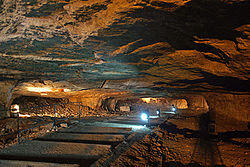
Cavemen Eruvin 61 “If a man spent Shabbat in  . . . a cave, even though it was like the cave of Zedekiah king of Judah , he may walk through the whole of it and two thousand cubits beyond.” The daf is obviously talking about a very large cave. What is the cave of King Zedekiah ? Rashi explains that it was a cave through which Zedekiah, the last king of Judah , escaped from the Babylonians. The escape is mentioned in the book of Jeremiah, chapter 52. Zedekiah and his soldiers escape from Jerusalem after the Babylonians breach the wall of the city. He is captured near the plains of Jericho . But there is no cave mentioned in the text.  Rashi again comes to our rescue (here, and with more detail in Ezekiel 12: 13) by telling us about a huge cave that stretched from Zedekiah’s house until the plains of Jericho . Where is this cave? Clearly it was known in the time of the Tannaim. And indeed we come across mentions of Zedekiah’s Cave from the time of the Gemara, t...
Image
Body and Soul   Eruvin 35   Amud Bet of this page discusses what structures are considered part of the city, for the purposes of extending city limits and knowing where to begin counting your two thousand amot limit outside the city. One of the buidings discussed is a nefesh . The Gemara explains that a nefesh that measures four by four amot can be considered part of the city, while one that has only two walls standing cannot. What is a nefesh ? Monumental Second Temple period graves consisted of two parts, a kever and a nefesh . The kever is just what it sounds like: the grave where the person is buried. Sometimes it is above ground, other times it is below. The nefesh is a second section, something that serves some of the functions of a gravestone today.  It is on top and often has a shape rising into the sky, to symbolize the soul ( nefesh ) returning to God. It is an imposing grave marker. One of the more famous graves with a nefesh that we see tod...
Image
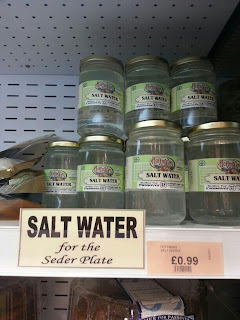
How many times should you dip? Eruvin 27   The  mishnah discussed on this daf includes a definition of what items may be used for an eruv hatzerot, as well as what can be purchased for your maaser sheni money in Jerusalem . The opinion of the mishnah is that all foods are fine, except water and salt, presumably because they are not considered food. However, Rabbi Eliezer and Rabbi Yosi ben Hanina hold a slightly different opinion. They suggest that while water OR salt may not be used, saltwater is permissible, since it is like a food. The question is, did the shops on the main drag in Second Temple Jerusalem sell ready-made saltwater, as they do today in certain American supermarkets? Thanks to Tamara Spitz for the idea.