Posts

Image
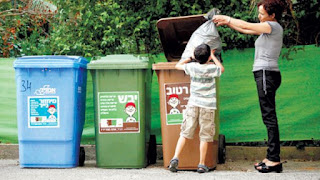
Take Out the Trash! Bava Kama 30 Today's daf (and previous ones) talk a lot about what public spaces looked like and what was allowed there. Today we discuss the specifics of throwing your garbage into the street as well as leaving it there to compost. What did ancient streets look like? Was there garbage collection? Seems like streets were pretty nasty places till very recently (the Ottoman Turks cleared away Jerusalem's garbage once a year) but a recent fascinating archaeological discovery suggests that Jerusalem actually had municipal garbage collection two thousand years ago. Here is the Haaretz article with certain relevant highlights bolded. Thanks Tzvi Bessin for the article! Today we are also advanced in our garbage collection   http://www.haaretz.com/jewish/ archaeology/.premium-1.727585     *Ha’aretz*   June 28, 2016 4:23 PM       *Archaeology*     *Ancient Romans, Jews Invented Trash Collection, Archaeology of Jerusalem ...
Image
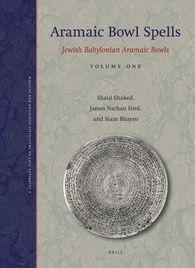
How to Get Rid of Pesky Demons   Gittin 68 The lengthy discussions about demons and Ashmedai in Gittin are not out of the realm of Gemara discourse but are certainly strange and completely unrelated to the topic of divorce.  Or are they? In a fascinating article   Avigail Manekin Bamberger shows that Aramaic incantation bowls discovered in Babylonia sometimes used the language of gittin to rid the house of demons. The bowls had a formula that bore similarities to divorce papers. They cite that this is a divorce between the owner of the house and Lilith (or another demon) and even include the standard וכל שום דאית ליה ; and any (other) name the owner has. Bamberger suggests that this shows how widespread and accepted the gittin formula was among Babylonian Jews, as well as how perhaps scribes could have written both writs of divorce and incantation bowls (gotta make a living). Divorce those demons and have a happy home! http://thegemara.com/naming-demons-...
Image
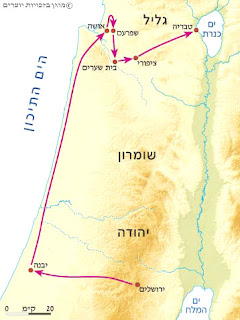
We'll Always Have Yavneh Gittin 56 Give me Yavneh and her sages תן לי יבנה וחכמיה .  Among the many stories presented in the Gemara, this vignette in Gittin, with Rabbi Yochanan ben Zakkai’s daring escape from Jerusalem and his prescient request of Vespasian is one of the most famous. We often tell it to help explicate how Judaism was able to survive one of its greatest catastrophes, the destruction of the Second Temple. But what is Yavneh? What did Rabbi Yochanan ben Zakkai really accomplish? And how? Yavneh was, and still is, a relatively small town, not near the major cities of the time: Jerusalem, Zippori, Caesaria.  It was part of the tribal area of Judah and was centrally located  – not far from the sea, near the coastal road, close to the metropolis of Lod. It had a Jewish and a Hellenized population in Second Temple times. And it was the first stop outside Jerusalem for the nomadic Sanhedrin: www.lib.cet.ac.il But most significantly, a...
Image
Gittin 21 A Real Page Turner We are in the midst of a discussion about valid writing materials for a get. Here are some fascinating websites I discovered that help us to picture and understand what Hazal are talking about. http://papyri.tripod.com/vellum/vellum.html See especially the end, about how parchment would often be erased and reused to write something else, exactly what the Mishnah is worried about. http://www.lib.umich.edu/papyrology-collection/ancient-writing-materials Different types of writing materials with great examples of each (see the “mummy tags” for wood). http://www.balashon.com/2008/02/daftar.html Nice blog post about the connection between the Greek word diftera, used in our Gemara to refer to a type of skin that may (or may not) be used for writing a get; and the Hebrew word daf.
Image
Mountains and Valleys Sotah 33 and 37 Before we delve into the geographic puzzles of Gittin, a few last words on Sotah. In the seventh chapter we have a comprehensive discussion of the blessings and curses given on Mt. Gerizim and Mt. Ebal. This is in the context of what must be recited in Hebrew and what can be said in any language. The mishnah explains the procedure for giving the blessings and curses and expounds on the verse in Devarim 11 that explains how to get to the mountains: ארץ הכנעני הישב בערבהמול הגלגל אצל אלוני מרה הלא המה בעבר הירדן אחרי דרך מבוא השמש Both are on the other side of the Jordan, beyond the west road that is in the land of the Canaanites who dwell in the Arabah – near Gilgal, by the terebinths of Moreh. (JPS trans.) There are many details in that verse, not all of them fitting together. The Gemara discusses whether מבוא השמש  means east or west, connects the story to Abraham who goes to Elon Moreh and brings in the Samaritans who i...
Image
Sotah 41 If Only One of Them Had Had a Nickname. . . In the discussion on our daf about the king reading from the Torah at the Hakhel ceremony, we have the fascinating story about King Agrippa. The Mishnah relates that he stood during the ceremony even though he was a king (the Gemara explains that that was because he was not from the house of David). When he reached the verse that forbids appointing a non-Jewish king, he started to cry, presumably since he was not fully Jewish. The crowd comforted him by saying אל תתירא אגריפס, אחינו אתה, אחינו אתה!   Do not fear Agrippa, you are our brother, you are our brother! The story suggests a number of things: that Agrippa’s Jewish ancestry is in doubt, that he is a righteous man and that he has public support. The question is, who was Agrippa? We know that Agippa was a king from the house of Herod, and also of Hasmonean lineage. Rashi states these facts and adds that he was king at the time of the destruction of the Temp...
Image
Sky of Blue Sotah 17 R. Meir used to say: Why is blue specified from all the varieties of colours? Because blue resembles [the colour of] the sea, and the sea resembles [the colour of] heaven, and heaven resembles [the colour of] the Throne of Glory, as it is said: And they saw the God of Israel and there was under His feet as it were a paved work of sapphire stone, and as it were the very heaven for clearness, 28   and it is written: The likeness of a throne as the appearance of a sapphire stone. 29 This famous saying explains why the color techelet, a beautiful shade of blue, was chosen for one fringe of the tzitzit . The rediscovery of how to make the techelet dye is a fascinating story and for that take a look at http://tekhelet.com// But the techelet color has also been an inspiration in Jewish art and in Jewish homes, particularly in the mystical city of Tzfat. So here, courtesy of Google images, are some memorable Tzfat techelet scenes.