Posts

Image
Mountains and Valleys Sotah 33 and 37 Before we delve into the geographic puzzles of Gittin, a few last words on Sotah. In the seventh chapter we have a comprehensive discussion of the blessings and curses given on Mt. Gerizim and Mt. Ebal. This is in the context of what must be recited in Hebrew and what can be said in any language. The mishnah explains the procedure for giving the blessings and curses and expounds on the verse in Devarim 11 that explains how to get to the mountains: ארץ הכנעני הישב בערבהמול הגלגל אצל אלוני מרה הלא המה בעבר הירדן אחרי דרך מבוא השמש Both are on the other side of the Jordan, beyond the west road that is in the land of the Canaanites who dwell in the Arabah – near Gilgal, by the terebinths of Moreh. (JPS trans.) There are many details in that verse, not all of them fitting together. The Gemara discusses whether מבוא השמש  means east or west, connects the story to Abraham who goes to Elon Moreh and brings in the Samaritans who i...
Image
Sotah 41 If Only One of Them Had Had a Nickname. . . In the discussion on our daf about the king reading from the Torah at the Hakhel ceremony, we have the fascinating story about King Agrippa. The Mishnah relates that he stood during the ceremony even though he was a king (the Gemara explains that that was because he was not from the house of David). When he reached the verse that forbids appointing a non-Jewish king, he started to cry, presumably since he was not fully Jewish. The crowd comforted him by saying אל תתירא אגריפס, אחינו אתה, אחינו אתה!   Do not fear Agrippa, you are our brother, you are our brother! The story suggests a number of things: that Agrippa’s Jewish ancestry is in doubt, that he is a righteous man and that he has public support. The question is, who was Agrippa? We know that Agippa was a king from the house of Herod, and also of Hasmonean lineage. Rashi states these facts and adds that he was king at the time of the destruction of the Temp...
Image
Sky of Blue Sotah 17 R. Meir used to say: Why is blue specified from all the varieties of colours? Because blue resembles [the colour of] the sea, and the sea resembles [the colour of] heaven, and heaven resembles [the colour of] the Throne of Glory, as it is said: And they saw the God of Israel and there was under His feet as it were a paved work of sapphire stone, and as it were the very heaven for clearness, 28   and it is written: The likeness of a throne as the appearance of a sapphire stone. 29 This famous saying explains why the color techelet, a beautiful shade of blue, was chosen for one fringe of the tzitzit . The rediscovery of how to make the techelet dye is a fascinating story and for that take a look at http://tekhelet.com// But the techelet color has also been an inspiration in Jewish art and in Jewish homes, particularly in the mystical city of Tzfat. So here, courtesy of Google images, are some memorable Tzfat techelet scenes. 
Image
Land of (Wheat) and Barley Sotah 14 After explaining how a Sotah offering is different from other offerings, the Mishnah brings a statement by Rabban Gamliel. He explains that the offering is made of barley because barley is animal food. . Continuing the train of thought of the last chapter, that God acts with you in a reciprocal manner, he explains that the Sotah acted in a manner befitting animals so she brings animal food as an offering. Let’s talk about barley, שעורה . It is one of the seven species that the land of Israel is blessed with, along with wheat, grapes, figs, pomegranates, olives and dates. It is brought as the Omer offering on the second day of Pesach. And it is definitely a staple crop. So why the second-rate status? Barley was always an important crop. It ripens earlier than wheat (see the plague of hail in Egypt, which ruined the barley crop but not the wheat which was not ready yet Shmot 10:31-32) and has many nutrients. But it also contain...
Image
Masekhet Sotah Parshandata I have always loved Rashi. I started learning Rashi with Chumash in grade school and studied about Rashi in the context of medieval Europe and the Crusades in college.  I even wrote a paper on him for graduate school. Now that I am learning the daf, my appreciation for Rashi has grown even greater as he is the ultimate guide to the complexities of the Talmud. I seem to recall a saying that God gave you two hands so that one could hold the place in the text and the other could hold the place in Rashi, since you needed to be looking at them simultaneously. Simply put, Rashi is the king, or, as one of his nicknames puts it, “Parshandata, “ THE parshan (commentator), a play on a name in the Megillah. So I have been less than happy having only “pseudo- Rashi” for masekhtot Nedarim and Nazir. While the insights of this mysterious commentator are often helpful, they do not provide the level of explanation and hand-holding that Rashi does. So in honor ...
Image
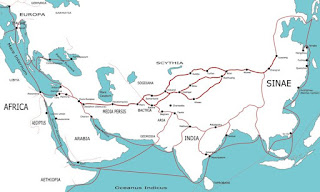
Under the Swaying Palms   Nazir 47   In the mishnah on this daf we hear about a second woman who joins Queen Helene in becoming a Nazirite. her name is Miriam and she is from Tadmor (most commentaries correct the text that says Tarmod and make it Tadmor). Unfortunately, nothing is known about this Miriam but her homeland is  well known in both Jewish and non-Jewish sources. Tadmor, otherwise known as Palmyra, has been in the news lately because it is now controlled by ISIS and they have deliberately destroyed some of the fabulous antiquities there. But let’s go back in history to happier times. Tadmor/Palmyra seems to derive its name from the tamar, the palm tree. It is a desert oasis on one of the main caravan routes through the Syrian Desert: (Wikipedia) Because of its strategic location, Tadmor was already settled in prehistoric times and by Biblical times it beame a main stop on the caravan route. It was settled by Arameans and Arabs and later b...
Money Down the Drain Nazir 24 The mishnah here gets into complicated cases of what happens to money set aside for Nazir sacrifices if the sacrifices can no longer be brought. The money for a sin offering חטאת cannot be used for anything else and therefore the coins have to be disposed of. In the language of the mishnah: יוליכם לים המלח, bring them to the Dead Sea. The Dead Sea is the mishnaic equivalent of flushing something down the toilet, ensuring that it can never be used or even found again. About ten years ago a huge cache of Hasmonean coins was found in the Dead Sea. Among the suggestions of where they came from is one connected to this idea, of coins that needed to be disposed of because they could not (or would not!) be brought to the Temple. The articles are below. > ​ http://www.haaretz.com/print- edition/features/pennies-from- heaven-or-elsewhere-1.133313 > >  http://sfile.f-static.com/ image/users/240224/ftp/my_ files/ITAMR/In%20for%20a% 20Penny%20-%20I...